Sunday, 5 March 2023

Courgette and Tomato

 Ingredients

1 large courgette cut into quarters lengthways then into similar thickness slices
3 tinned tomatoes and 4 Tbspn of their juices, chopped.
1 Tbspn tomato puree
1 garlic coarsely chopped
small red chilli, cut into quarters lengthways, deseeded and finely cut into strips
3 fresh tomatoes, cut in half then each half in thirds.
2 Tbspn oil
2 Tbspn chopped parsley

Method 

Heat oil in large pan, put in garlic and chilli, stir and cook for a minute. Then put in courgette for about 4 minutes, stirring occasionally so as to not colour. Put in tinned tomato, juice and puree, turn up heat high, stirring until all moisture has reduced. Put in fresh tomato, stir, as you lower the heat, until the fresh tomato begins to soften. Stir in parsley, check seasoning and serve.


Big Bean Casserole

Ingredients

 400g Jonny Beans soaked over night (or dried broad beans)
110 g of speck cut into 8mm dice
2 x medium onions, carrots, celery  all cut into 5mm rings
3 cloves of garlic coarsely chopped
500g Belly Pork scored  into 40mm2
12 chicken wings
300g smoked continental sausage cut into 20mm slices
1L of chicken stock about.
3 bay leaves.
Tbspn black peppercorns, salt to taste 

Method 

Boil beans in soaking water for ten minutes, drain, rinse and reserve.
In a large pan fry off the speck until the fats run and the dice colours, draw off and put in casserole. Fry chicken wings in batches so each side takes on a good colour and pack tightly into bottom of casserole.
Lower heat and sweat off onion, carrot, celery and garlic.
Pack drained beans on top of the wings, scatter peppercorns and bay leaves.
Spreading onions, carrot, celery, garlic over top of beans.
Pour in sufficient stock to cover beans well. 
Push belly pork into mixture until the rind is only just above the water.
Cover and cook in a fan oven 180°C for 2 hours. After one hour remove cover. After a further half hour push the sausage slice into the water, check the beans are soft. 
Check seasoning and Serve.


Sunday, 26 February 2023

Dinosaur Ribs

 Just have to share this one whilst it is still fresh. So one family enjoy hand food eating the meat off the bone. I decide to give them a Dinosaur Rib each. Had no idea what I was letting myself in for other than they would be about 20cm long and obviously the thin end of the rib with little meat. My preferred source, Great Berwick with their Longhorn cattle, were able to supply. Came the day, they arrived and wow they were huge.


Looked online for guidance, nearly all were USofA inspired and aimed at BBQ but all with conflicting treatment and most of all timings. I knew that they would have to be slow cooked. Picking my way between them I went with an overnight marinade. Tbspn Smoked Paprika, dstspn dried Oregano, tspn ground cumin, dstspn ground Sichuan pepper (cos I had it), salt and about 4Tspn of oil. Rubbed well into meat sides, covered and left. smelt good.

I hummed and hawed over cooking times and the 7hrs at 130degreesC seemed excessive compared to what I had been looking at. Settled for 5hrs with a check after 4hrs leaving myself a margin. Pairs of ribs were wrapped and sealed into foil, the best way I could manage them, then pooed into the oven. Even then spacing was tight and a corner of foil caught on the racking as it went in.

Impatiently waited for the four hours, so tempted to have a peek. At 4hrs it was clear they were not going to be done, so PlanB, turned it up to 150degreesC and settled for another hour and half. Took them out after 5.5hrs. The torn foil allowed the plentiful juices to flood out, what a mess. Arranged them on a tray and brushed their meat surfaces with Grape Syrup, which I happened to have, a less aggressive basting than all the BBQ sauces online raved about. Popped them under a high grill for a few moments.


As the dish was brought in there were eyes wide open. Tucked in with gusto and I was left with cleaned ribs, so a huge success! Chef's afterthoughts.  It was cooked, easily eatable but not a fall off the bone as I had planned for. Reckon the 7hrs at 130 would have been about right. The marinade didnt make a huge difference, the air-aged beef and being Longhorn had its over very distinctive flavour. They did throw off a lot of fat and juices. Finding a honey based glaze would be a better answer, straight out of the foil wrapping, too pale and not appealing.


Monday, 20 February 2023

Vension Shank

 Been some time since I recorded anything here. Not that I havent produced some knockout dishes, just didnt get round to recording them or as ever taking any photos. Yet another missed photo opportunity. If only I could capture the smells to share with you. So another venison, shank this time, again in the slow cooker.

  •  1 shank of venison on the bone
  • 4/5 Tbspn olive oil
  • 2 large onions
  • 2 good sized carrots
  • 4 cloves garlic
  • tspn pepper corns
  • 12 juniper berries
  • 150mm ish of orange peel (without pith)
  • 700ml full bodied red wine
  • bouquet garni - 2stlk celery+leaves, 2 bay leaves, parsley, thyme, sage, rosemary
  • 8 charlotte potatoes, small left with skin on

Oil in skillet, get the pan really hot and sear all of the flesh on the shank to a good deep brown, place in the slow cooker. Turn down the heat, throw in the peeled thick sliced onions to sweat off, stir from time to time. Snuggle the bouquet garni, with herbs cased in the celery stalks cut in half lengthways and tied up with string, down against the shank. Peel and cut the carrots into 25mm long roundels, again snuggled down against the shank. Scatter over the coarsely chopped garlic, juniper berries peppercorns and salt to taste. When onions have softened tip in the red wine, cook briefly, stir then tip onions and wine over the shank so the onions cover the shank. Make sure carrots are under liquid.

Cover slow cooker set to low and cook for 7hrs. Around 3.5hrs turn shank onto other side, you may need to turn once more to ensure the tight ball of flesh that has shrunk up the bone gets cooking time in the liquid. Two hours before serving push the potatoes down into the liquid, remove the bouquet garni. by the seven hours you will feel that the meat has soften and easily pulls away. You will probably want to take out some of the juice, blend with flour then stir back in to thicken the richly smelling juices. Enjoy.


Monday, 8 February 2021

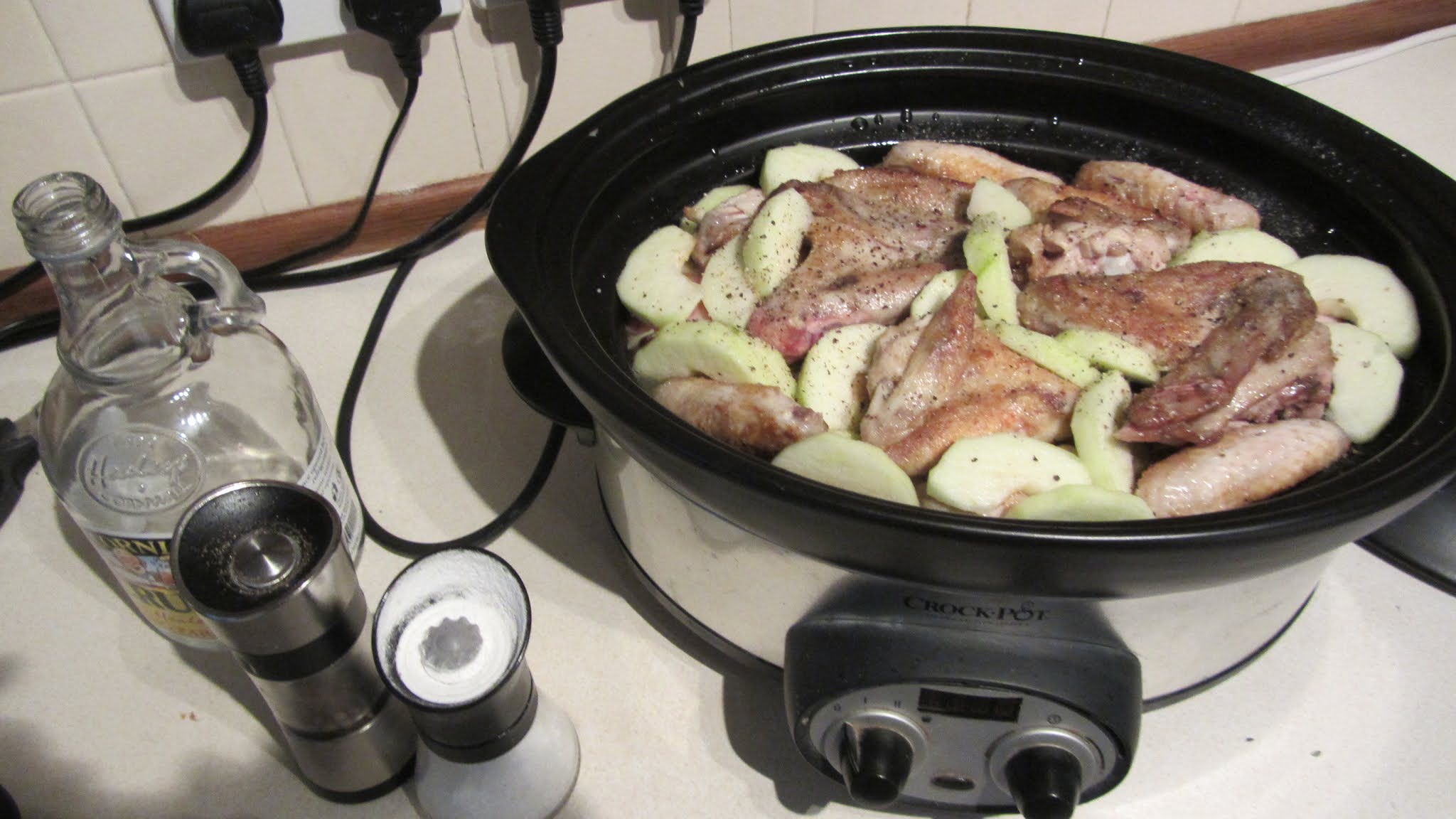
Slow Cook Chicken with Celery and Apple

This is my version of this dish which is good for a slow-cooker. Put the aromatics into the pot, parsley, thyme, bay leaf, garlic and lemon peel. You can see the quantities that I used you must adjust to suit the size of your pot and servings. 


Peel and core brambly apples, I used three, coarsely chop two and scatter over aromatics. Slice the remainder apple and reserve.

Clean and coarsely chop a head of celery and finely chop the leaves, scatter into pan.

together with a medium onion chopped


Optionally I used 3/4lb of belly pork, scored at 35mm centres and buried into the apple and celery. Meanwhile brown off chicken pieces in olive oil. I used 8 wings I happened to have.

Pour 1L of cider, I used Scrumpy into the pot, remembering to slacken the frying pan residues and also add. Push the chicken pieces down into the sides and across the top. Then scatter the reserved apple slices across the top


Season well to taste, cover and cook! I used 5hrs at the low setting and I guess 3.5hrs on high.


All done, just enjoy. You might want to take off some of the liquid and reduce it but that is down to you.

Simple easy and tasty.


Sunday, 7 February 2021

Bean Salad with Confit Duck

 Quick and simple yet turned out refreshing and tasty. A can of red kidney beans and a can of cannelloni beans, rinse well, drain and put into a bowl. Finely chop a medium onion, add to bowl with a Tblspn of white wine vinegar. Very finely chop a green chilli, without the seeds, together with half a cup of chopped parsley, add to bowl. Shred a duck leg confit into thin strips, add to bowl, season to taste add 2Tblspn olive oil and mix well. Leave to absorb flavours, enjoy


Wednesday, 20 January 2021

Muntjac Haunch on bone - SlowCooked

 As so often, failed to take any photos as pushed to get it done. Have had muntjac haunch before but underwhelmed as flavour was so mild it scarcely came through. This haunch is small but should still be enough to feed four people.This time set about it differently. Decided to pot roast it in a slow cooker on a bed of sweet vegetables. It worked a treat. The vegetable enhanced and married to the venison flavour, the meat was so tender, it was a knockout. Try it and see if you agree. 

In a very hot skillet with a cup of (olive) oil sear the haunch until brown on all sides, set aside. In the same skillet, reduce heat to low and toss in the stalks of a head of celery cut in 15mm slices, together with the leaf stalk ends and the heart. Add two medium onions chopped into comparable sizes to celery. Stir and let sweat until onions become transparent. Raise heat again and pour in 2/3rd bottle white wine until it bubbles vigorously. Tip contents of skillet into the slow cooker. Add about 12 juniper berries, teaspoon of peppercorns, dessert-spoon of dried oregano (preferably fresh if to hand), three bay leaves and four cloves of garlic coarsely chopped. Top with chicken stock until liquid is around an inch deep. Place haunch ontop of these vegetables. (optional, cover top of haunch with four rashers of smoked bacon). Set SlowCooker to high and leave for 3 -3.5 hours. Resist temptation to lift lid! The developing smell will tell when it is nearing ready, I checked meat with thermometer for 70C.

Take out haunch and rest it.

Scoop all the vegetables to one side, strain and pour off all the liquid into a pan and boil and reduce until it just begins to thicken. Add two tablespoons of redcurrant jelly, adjust seasoning. As I had them, I added two handfuls of fresh cranberries at the last minute.

Slice meat and serve on a bed of the vegetables (and bacon cut into thin strips), discarding any large pieces, then pour the sauce over the meat.  Serve and enjoy!

  • haunch of muntjac on bone 
  • cup of oil
  • head of celery
  • 2 medium onions
  • peppercorns
  • 3 bay leaves
  • 12 juniper berries
  • 4 cloves garlic 
  • 1 dstspn dried oregano
  • white wine
  • chicken stock
  • 4 smkd bacon rashers (optional)
  • Tblspn redcurrant jelly
  • seasoning


Monday, 19 August 2019

Pork medallions with mushroom

Very pleased how this one came out.

Take a few dried Porcini mushrooms, crumple until about 1Tblspn then soak in a cup of boiling water  Cut six medallions, 4cm thick, out of a pork tenderloin. In a hot skillet sear each face in butter to colour. Place in a hot oven, 200C, for about ten minutes, reserve.
Meanwhile trim, removing the coarse stalks, of 1/2lb chestnut mushroom into thick slices together with a box of mixed wild mushrooms. Keep the trimmings add to the porcini then bring the trimmings to a simmer, adding the juices from the reserved medallions. In the same skillet add more butter and fry off at a medium heat all the mushroom slices until they lose water, colour slightly and become soft. Reserve.
Finely dice a large white onion and sweat off in the skillet with more butter if necessary, raise temperature drive of the liquid until the fat runs then strain the trimmings stock over the onions. Leave to simmer until the stock has fully reduced.
Make a thick white sauce, blending 1.5 Tblspn into 2oz butter then stir adding about 1/2pint of milk, keep stirring until the sauce is thick and smooth. Combine with the reserved onions and then add 2Tblspn of double cream and the last minute, final stir to fully combine.
In an oven proof dish just large enough to take the medallions with room to spare, sprinkle the base with two sprigs of finely chopped sage and a crushed garlic. Space the medallions the scoop the mushrooms into the spare spaces and push them into all the gaps.
Finally cover the mushrooms and medallions with the white sauce.

 
Place in a hot, 200C oven from about 20 minutes or until the top begins to colour.
Enjoy

Sunday, 3 February 2019

Smoked Gurnard

Been meaning to share this for some time. Nothing to it but it transforms the humble Gurnard into a  meal worth remembering.
Gurnard - a fish with attitude
 So long as you work either side of the central scale ribbon running along its back, whilst avoiding its spines, filleting is straightforward. There is a lot of bone and head for fairly small fillets, so choose a good sized one that looks plump, not wasted post spawning. Unless you want to make some fish stock, you will probably want to get the fishmonger to fillet it for you.
Get out your Camerons smoker, or similar and scatter a small handful of Alder chips around the base. This time I used Apple chips but to my mind it was not as good, so go for Alder if you can. Lightly oil the grid, wipe the open flesh sides of the fillets with oil, a twist of pepper then place flesh side down on the grid. Repeat with the top skin sides and assemble smoker. Put on a just a little higher than medium hotplate, wait until some smoke escape and time for around eight minutes. It really doesn't need very long at all. Check, touch to make sure the flesh is cooked. Take off heat and reserve then serve. It is excellent, hot or cold, needs no further embellishment. As you can see, I dressed it with lightly pickled pink shallot rings.


Thursday, 24 January 2019

Crab Flan

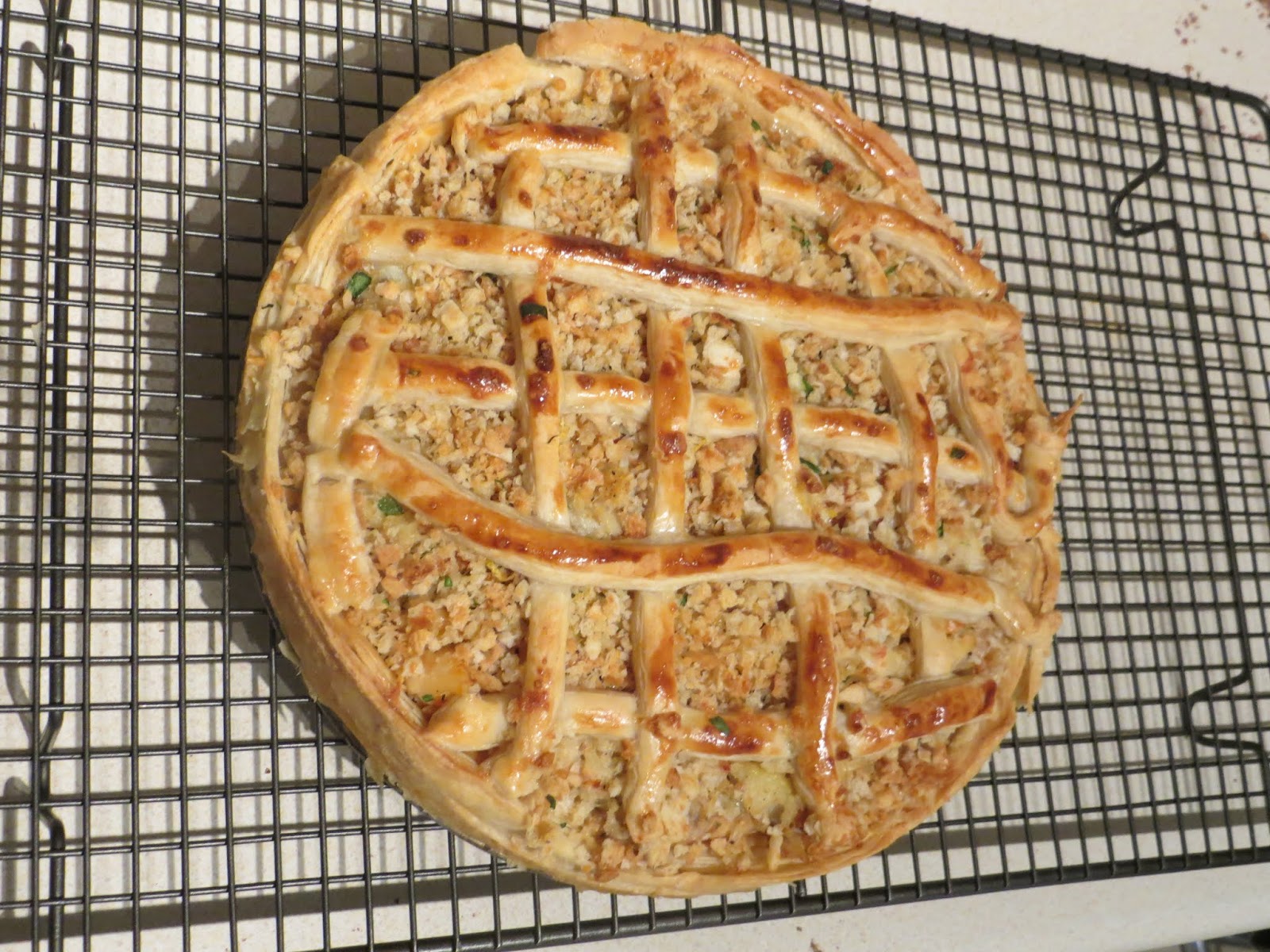
This stood out from all the dishes I have been doing over the last couple of years that were usually variations on down-loaded themes. This one I believe is original. Confession number one, I have avoided pastry up until now, because of past dismal failures. So it was with some trepidation that I embarked on this one, my first pastry dish. Second confession, I used shop bought Puff Pastry. I know the shame and the convenience! Just make sure it is an all butter recipe. If you going to spend time and money making this, might as well make it the best you can. Third confession, I did not weigh or record anything and used my eye for judgement. So be warned my quantities are approximate, adjust yours to meet your instincts. So lets kick off.

Roll out (snigger, unroll) puff pastry made previously and cut out the base for a 8" diameter flan case, with removeable bottom. Cut even width strips, 1.5" wide to form the sides. Cut the remember pastry into half inch strips for the top lattice. Prepare your flan dish and line the base and sides, remember to wet just the base edge and press in the sides to seal. Return all pastry to frig.

Take quarter pound of white crab meat, check for chitin, toss with zest of a lime, dessertspoon of chopped tarragon (goes easy, don't want the tarragon to dominate), a drizzle of lime juice and pepper. Set aside. Finely chop a red onion and sweat off in an ounce of butter,  Don't overcook it, retain some bite to it, set aside. Make a thick béchamel sauce with 1.5 Tbspn plain flour, 2oz of butter, when flour and butter combined and cooked for a moment, loosen with quarter pint of full milk, keep adding milk slowly and stirring all the time until milk used up and the sauce has become thick, smooth and creamy. Stir in two Tbspn of brown crab meat and the reserved onion. Meanwhile liberally coat inside the flan pastry with one egg yolk, prick the base (oophs I forgot to do this) and bake in middle of hot oven 200°C for ten minutes. Back to the sauce, drizzle 12 drops of tabasco and stir into the sauce, check and add a few more drops at a time until the sauce has just the edge of a kick. Again do not want it to dominate and you cannot take it out if you over do it! Simmer very gently until you have the right consistency and then for the final flourish add in a Tbspn or two of cream. Keep warm. Finely grate about 2oz. of Gruyere and mix with three handfuls of coarse white breadcrumbs and zest of lime.

Now to assemble. sprinkle a dspn of semolina across the flan base, then spread a packet (70g) of brown shrimps. Cover with the béchamel sauce and then spread the white crab meat, finally topping with the breadcrumb and gruyere to completely cover the crab meat. Take the thin strips and form an open plait across the top, brush with egg yolk, then back into the hot oven, 200°C, for about 20 mins, but keep an eye on it.
Eat hot or cold and enjoy.

You will see that my pastry skills have a long way to go, but a step in the right direction?

Monday, 17 September 2018

Tasty Lunch variation

Clearly I love my sprats on toast with tomato. Tried out this variation and, can you believe it was even better! First off it was helped that I used our own beef tomato that was so sweet and tender, such a difference compared to the hard flavourless commercial 'vine' tomatoes. So generally follow my previous Tasty Lunch post. But having butterfly filleted the sprats and cleaned the inside of the fillets with a kitchen towel, the next step is to take some very thin cut prosciutto ham and cut into long strips, the length of the slice, about 30mm wide. Layout on a board. Take each fillet with tail end, less fin, placed at the bottom edge of the ham with the rest of the fillet lying on the ham up towards the top. Cut a firm gherkin into long thick strips, about 6mm square and roughly 50mm long. Place a gherkin strip on the fillet end, then, making sure you pick up the end of the ham, roll is tightly up, place with the top end of ham at the bottom to keep it in shape. Now grill with a sprinkle of olive oil for about four minutes until fish flesh turns white and ham begins to crisp, Keep a watch and do not over cook them. Keep warm and set aside


Now time for the toast, lightly grilled, cut off the crust if you prefer and coated with your prepared tomato mixture (skinned tomato, shallot, garlic, olive oil, all lightly blitzed) taking it right to the edges and then place a line of thin raw tomato slices along the toast. Splash of oil put toast and tomato mixture under the grill briefly until the raw tomato just softens, remove, place the sprat rolls onto the toast and enjoy with a green salad.

The way to Damson Jam

Damson Jam has the greatest intense flavour and a great balance between intense sweetness and the bitter sharp undertones. But these small plums with the stones clinging onto the fruit are tiresome and laborious to prepare. I read across many recipes and this is the method I followed which has produced a well set jam, full on flavour and not unduly arduous to make. Weigh your just ripe damsons, (thank you Pixford Fruit Farm, Bishops Lydeard for perfect fruit) and weigh out an equal measure of granulated sugar. Put the sugar in a low oven to warm. Using a cherry stoner, remove the stones from each fruit keeping the fruit separate from the stones. The stones will cling on to some of the fruit depending on how ripe the damsons are. No matter. Put the de-stoned fruit into a large enough preserving pan so you have room to easily turn the fruit around and put over a very low heat. At this moment you are just warming the fruit through, getting the juices to flow. Put the stones and their clinging fruit into another saucepan together with a small quantity of water. I used just under three-quarter pint water to 5lb of fruit so you must adjust the water to suit your weight of fruit. Put onto a medium to high heat but watch and keep giving an occasional stir. Very quickly the pulp will begin to thicken the water which will easily catch and burn on the bottom of the pan, a good sign that these damson have a high pectin content. When the stones are clear of any pulp, time to use a colander, yes colander not a sieve, put the stones, pulp and juice into the colander over the preserving pan that holds the fruit and stir with a spoon until just the stones are left. Discard the stones. Now turn up the heat to about a medium heat and gently simmer the fruit and the pulp juice until  the fruit and skins are soft. Remember to keep stirring occasionally as the pulp will again catch and burn very easily on the bottom of the pan. If the pulp starts to get very thick, wash the stones with a very little water just enough to slacken the pulp. Be careful when adding water, too much and the fruit wont set or you will have to boil off excess water spoiling the deep flavour, not enough and it will catch and burn. The fruit will soften very quickly and doesn't need boiling. Time to add the sugar, raise heat to highest setting, stir until sugar dissolved. With a thermometer watch the temperature rise, give the odd stir to even the heat out, until 104°C is reached. This will happen very quickly, do a plate wrinkle test for peace of mind that you have a good set. Give a final stir to make sure all is at this temperature, check temperature again, then remove from heat. Skim off the scum and leave for 20 minutes before filling your pre-warmed jars. Screw the lids on tight and impatiently wait for the next day to try out this delicious jam.

Wednesday, 25 May 2016

Couple of Ideas

Bought sea caught Grey Mullet, which needs a bit of care to bring it to life. Cooked it whole, gutted and descaled, stuffed the belly with ginger slices, a few chilli slices and the green heads of spring onions. Laid it on oiled and seasoned greaseproof paper that I scattered with a generous handful of refreshed wasabi (seaweed). Wrapped it up papillote style and cooked in a fan oven at 180°C for 40mins. turning it over 2/3rd of cooking time.
 
 Took the skin off, lifted the fillet off the bone and served with some of the cooking juices,


Was not the outstanding success expected, cooked just a little too long, still moist but I think cooking could be reduced by 10mins. Wasabe didn't have the impact expected so would probably not repeat. Definitely step up the ginger and chilli to give a bigger kick. Any suggestions welcomed!

To go with it, and to use an abundance of spinach I had at the moment,  I washed, stripped the stalks, spun dry and shredded about 1lb of spinach. Threw that into a very hot pan with a knob of butter and kept stirring to avoid catching and to drive off any lingering water. As it wilted and largely collapsed I then threw the retained ends of two bunches of spring onion which had been sliced along the length into slivers, think julienne but not so fussy.
 
Job done, time to serve, topping the spinach with a warmed soft boiled quails egg. Tasted good even if not outstanding!

I even remembered to take a photo!


Monday, 18 January 2016

Jam Making

I have a confession. Been making jam/marmalade for years. Usually manage to get good flavour, usually avoiding over caramelising the sugar but so seldom have my sets come out right. Done all the reading, done all the tests, finger test, temperature, pectin but mostly to no avail, even for those sure fire jams that novices can do with their eyes closed! Recent years I have got so despondent I spoke frequently of giving up and do no more, but, that taste of homemade is so superior I end up trying for that one more time.

A few caveats, I do not use commercial setting agents or pectin's, except in extremis. I reckon that what with all the mess for washing up, all the waste of scum or residue on a variety of tools pots and pans and processing time spent it is better to do one large batch than a number of small ones. In anycase I seems I still have a family if not to feed then to pass jars onto.

Just completed this years Dundee and also a Seville Marmalade, its looking like I may have cracked it at last. Hence this posting just incase it helps anyone out there floundering like me. Or some sharp eyed maestro can spot the errors of my ways!
 
I now routinely use a digital thermometer with a set (104°C) temperature alarm. Past reading has also highlighted, amongst other things, the need to bring the temperature up quickly and to work in small batches. But no this was not small batches, it was one large batch in my usual large preserving pan that oversails the ceramic top hob. So what was new. Well paid a lot attention to reducing the liquor level well beyond the recipe level before adding the pre-warmed sugar. My concern is not volume produced but that whatever is produced sets well. Watching the temperature rise it took a long time coming even though the probe was in the middle of the rolling boil and off the bottom. In fact it never reached a high enough temperature to trigger the temperature alarm (on my thermometer it waits until 105°C). When I stirred to make sure there was no sticking on the bottom, it happens, the temperature plummeted by almost 20°C then took a long time to get back, frequently oscillating up and down.

This then is what I have discovered. It is not just enough that the probe shows the desired temperature but the whole of the jam has to get up to that temperature. That means, leaving it alone, only folding the pan edges in at the last moment before leaving it to recover. It will take longer than the book says, particularly if your pot is wider than the heating source. It is a tightrope walk, overcook it then it caramelises, undercook it then the bulk is still under temperature, stir it and you lose massive heat, not sir it and the edges are too cold.

Don't despair, make sure your liquor is reduced well before adding the sugar then watch the temperature fluctuations and wait until it is fairly stable and you know the edges have recently been bought in. You can do it. It is worth it.

Sunday, 22 November 2015

tasty lunch

From time to time our fishmonger has sprats. They are now in season. This is our favourite way of having them as a lunch. Butterfly fillet a dozen sprats, leave just the tail fins on. Try to get the larger ones and ones still intact, not too chewed up. Cost you less than a £!. Skin and de-seed three tomatoes then finely chop and crush with a fork. Add one crushed clove of garlic and one stem of spring onion finely chopped, season and mix well. Toast six slices of bread. Sprinkle each slice with olive oil spread with a generous layer of the tomato mixture and lay two sprat fillets head to tail, skin side up. Drizzle with oil and return to grill briefly. They will only take a couple of minutes so watch carefully. Lift a fillet up gently to check that flesh has turned opaque. Serve with a light green salad.

Friday, 6 November 2015

Partridge Medley

Still chuffed about the other meal last weekend. No pics again so use your imaginations, this was a reworking of something I did recently. Four partridge was the offer we couldn't refuse. So took the breasts off the birds and set them aside. Then took off all the other useable meats. Carcasses went into a stockpot with an onion and a carrot and a glass of red wine, water to barely cover, then simmered gently.
Checked all the meat for possible shot. The other useable meats I minced on a coarse grade. Then re-minced it again this time with about six spring onions and 8-12 soft no soak prunes. Make sure you mix the prunes in else they will clog up the mincer. Into this mixture one small egg, Tbsp fine chop parsley, 1.5 Tbsp chestnut flour, pepper and 1/8th tsp of cayenne. Mix well together. With wet hands take 30gms of mince mix firm up and roll into balls, should make around 15. They will hold together easily.
Strain of stock into a clean pan, bring back to a very gentle simmer and carefully roll the balls into the stock in batches, after about 15min lift out to dry and set. Roll in chestnut flour, dip in another beaten egg then roll in coarse breadcrumbs.
Now to put it all together. In a hot skillet add a large knob of butter, pan fry the breasts, turning on the two sides and the neck end until coloured and inner flesh just has a line of pink still. Pat dry and rest in a warm place for ten minutes. In a pan of hot oil slide the breadcrumbed balls into the oil for around 6 mins or until they are evenly coloured. Lift out, drain. Assemble your plate, sit back and feast!

Tuesday, 3 November 2015

panfried scallops

We were in our fishshop and the scallops stared at me saying buy,buy. So we did.

I lightly toasted slices, crusts off, of my 80% white bread, then drizzled them with olive oil and sprinkled with crushed garlic. On one half I put a thick slice off a beef tomato and over the other half two thin slices of gruyere cheese. Back into the still warm grill to finish off. Meanwhile I pan seared my wiped clean scallops in butter until just firm then rested them for a few minutes in a warm place.

Served with two strands of chives and scallop on top of the tomato and a light salad What delicious lunch!


Wednesday, 6 May 2015

my Chill Con Carne

There are a lot of chilli con carne recipes out there, often with wide ranging ingredient plus a couple of exotics like chocolate or coffee. I wanted to get back to what a more simple traditional dish may have been like. It seems to shout out for a slow cook pot. So here is my take on it.

Ingredients
1kg Shin of beef
lard or oil
500gm dried red kidney beans
3 onions sliced
3 cloves garlic sliced
I red pepper
3 red chillies
bunch fresh coriander leaves
1.5 pint good stock
2 tspn ground cumin
2 tspn dried oregano
salt and pepper
1Tbspn treacle
6 plum tomatoes

First off soak the kidney beans over night. Wash and drain until water runs clear then put them on the stove, bring to the boil, and this is important, rapid boil for at least ten minutes.
Meanwhile cut the shin into a small dice. Most recipes call for mince, for one you never know what is in 'mince' and secondly I wanted to get more texture out of the beef. Put about two tablespoons oil in a pan over a high heat fry off the beef in batches until the moisture is driven off and the meat just begins to colour. Transfer to the cookpot and carry on with the next batch, adding more oil as needed. Drain the kidney beans, rinse well, then add to the meat in the cookpot

When the meat has browned and transferred into cookpot, reduce pan to low heat, put in the onion and garlic slices, stir and let them sweat. They will take on colour from the meat but do not brown them.
 
Cover and leave on the low heat until softened.
Prepare the peppers and chillies, deseed then medium chop. Cut the old ends of the coriander and fine chop about four tablespoons of stalks and leaves. 

When onion and garlic has softened but not coloured, turn heat up high, drive of any moisture then and put in the peppers, chille, cumin and oregano, stir and leave for a few moments.
 
Now add about 1.5pints of a good stock and the coriander, let it come to the simmer and leave for a couple of minutes.

Mix the meat and the kidney beans together then add the stock, spices, peppers, chillies and coriander.

The liquid should just about cover the beans, add a little more if necessary. To ensure the beans cook thoroughly I have kept the water level high and I set the cooker onto high for eight hours. This was too long and six hours should be sufficient, depending on how old your beans are.
Halfway through the cooking time, give the pot a good stir and reduce to the low setting for the remainder time. Test for tender beans and meat that falls apart in your mouth or give a little longer cooking. Drain the juice out of the cookpot and transfer into a pan, reduce over a high heat adding a tablespoon of treacle. As the juices reduce and thicken the chillie heat will amalgamate and blend to a degree. Take off heat when reduced to about two cupful's.
Coarsely chop six plum tomatoes and a few more coriander leaves.
Add to the cookpot the tomato, coriander with the reduced juices, give a good gentle stir, leave to warm for half an hour. Then enjoy!


Sunday, 22 February 2015

pigeon breast

A compilation menu, came across a pack of six pigeon breasts that I just had to buy.

Marinated the pigeon breasts in Masala, garlic, crushed peppercorn and thyme for a few hours, turning from time to time. Lifted the breast out of the marinade and set aside. Put a generous handful of dried porcini mushroom slices into the marinade with 6 juniper berries and half a glass of red wine. Put it on a low heat, stirring from time to time.

In meantime sautéed par-boiled potato slices in the oven where I roasted oiled fresh baby beetroot wrapped in tinfoil.

Got a skillet really hot, in grapeseed oil flashed fried the pigeon breast, just 2-3 minutes each side. The Masala will cause them to go dark brown quickly. When judged sufficiently cooked removed and set aside to keep warm for another 5 minutes. Had some leftover seedless red grapes, so halved them and threw them into the residual oil with a splash of white wine, tossed them to drive off some of the wine. By this time the porcini mushrooms liquor had reduced to a thick sauce.

Time to plate.

Thickly sliced breast onto the porcini mushrooms (removing the juniper berries). A baby beetroot to one side, then a range of potato slices, a dab of grapes with their jus and some steamed cabbage slices. Wow what a balance of flavours and textures.

Sunday, 1 February 2015

Soused Mackerel

Fillet and pin bone two mackerel. Set aside. In a shallow dish sufficient to take a pair of fillets side by side, strew bottom with two bay leaves, 12 white peppercorns crushed, 5 juniper berries quartered and one onion thinly shaved on a mandolin. Arrange opposing fillets on top and scatter some English mustard power over them. Strew to cover with another shaved onion. In one to two proportions sprinkle about dessert spoon of white wine vinegar followed by olive oil. Cover dish with one large tomato in 5mm slices then sprinkle with coarse breadcrumbs. Cover with well buttered greaseproof paper and put into a hot oven 180C for just under half hour. Take off greaseproof and put dish under grill until golden. Delicious